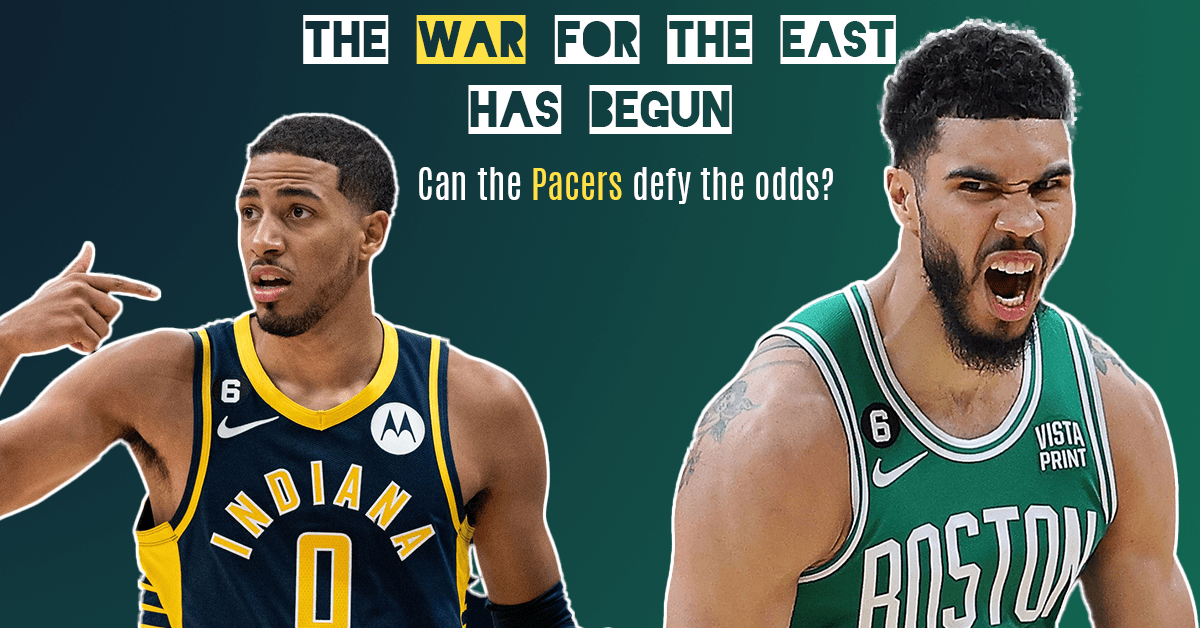
The Indiana Pacers aren’t supposed to be in the Eastern Conference Finals. From the beginning of the season, the team absolutely showed a promising future. They would be great— in a couple of years. Against the odds, though, they have proven themselves to be a force, stunning both short-handed Milwaukee and New York. The narrative is clear: if not for injuries to key players, the Pacers surely would have folded… right? They don’t play any defense… right? Haliburton has struggled since the playoffs began… right?
Let’s put the cards on the table: the Pacers should have left TD Garden with a victory in game one. The win was in the palm of their hand, yet it slipped away. While the loss may haunt the organization and its fans for a while, Indy faithful should take the game as a relative positive. The game being winnable with Indy in the driver’s seat late was certainly unexpected. Moreover, the Pacers played an absurdly sloppy game, but it took the consensus best team in the NBA an overtime period to beat them. Despite the loss, the Pacers cemented themselves as real contenders armed with the most dangerous weapon in sports: hope.
So how do they adjust to win game two tonight? The first and most obvious answer is reducing the number of turnovers. Indiana gave the ball away 21 times, and the Celtics made them pay with 32 points scored off turnovers. The Celtics are good enough on their own, they don’t need the ball donated to them.
The second obvious issue to address is the lack of free throw attempts. The Pacers shot a whopping 10 free throws to Boston’s 30. That disparity is absolutely unacceptable. They have to be more aggressive.
The free throw problem has a relatively easy fix. First, take a look at this graph from NBA University.
The vaunted Celtics defense seems to have a crack: they have a hard time defending P&R. Now, the above chart also indicates Indiana’s struggle to produce points out of the same action, but humor me.
With Kristaps Porzingis sidelined until at least game three, the Pacers have an opportunity to exploit the weakness created by his absence. Al Horford is a valuable player, but he’s not as quick as he used to be. He played drop coverage the whole game, and the Pacers actually did well to exploit it at times. Pascal Siakam shot the lights out with Horford as his defender in the P&R. Haliburton went 3-for-4 with Horford in drop. That is going to be a huge key to game two. This could be the key to free throws if instead of settling for jumpers, they attack the drop more. Just a thought.
They really need to target Payton Pritchard while they’re at it. The guy is 6’1. The Pacers got some nice matchups with Pritchard on the floor.
For a team that loves to switch everything, Pritchard is a weak link. When he’s on the floor, Indiana has to find a way to exploit his size.
Just as a side note, I think it would be wise to give Obi Toppin more playing time. He’s another big, strong, and athletic body to roll out against a mostly huge Celtics lineup. A locked-in Toppin provides energy and size the Pacers could use. Especially once Nesmith fouled out, the right call would have been bringing in Toppin. If Pritchard is in the game, Toppin should be as well.
Just to further prove my point, check out this play early in the fourth.
Toppin’s size and leaping ability basically create this wide open corner three
Defense was a mixed bag for Indiana. Like, why wasn’t Siakam guarding Tatum the whole game? Part of the reason you trade to get a player of his skillset is his defense. Let him take the matchup early.
On the one hand, they mostly did well shrinking the floor when Tatum and Brown had iso opportunities (some good boxes-and-elbows looks). On the other hand, the execution fell apart at the worst possible time. Observe.
Nesmith has to recover faster off that screen. But more confoundingly, why is Haliburton closing out to Horford to leave Derrick White wide open for the highest quality shot in NBA basketball (a wide open corner 3). Of the shots available, I’m sure Indiana would take the Horford attempt every single time. Old Man Al went 3-for-12 from three. Not a great decision at such a crucial time in the game.
It’s not all doom and gloom for Indiana. A lot went right for them. Many detractors had to swallow their pride as Boston didn’t exactly steamroll them, so many “experts” remaining quiet after the hard-fought battle. Game two is going to be fun tonight, and if the Pacers steal a game in enemy territory, it will be a brand new series.
There was a point during the December 2nd matchup between the Dallas Mavericks and OKC Thunder where the Mavs had scored 30 unanswered points. There is an old adage to the tune of “It’s not about how you start, it’s about how you finish.” Clearly, that is a proverb the Mavs believe in, as this scoring and defensive stand came in the fourth quarter. The Mavs trailed and they knew they needed something special if they were going to pull out the win. While they ultimately lost, their fourth quarter was nothing short of spectacular, outsourcing their opponent 36-19.
Achievement bereft of context is meaningless, so allow me to contextualize. Going into the fourth quarter, the scoreboard read 107-84 in favor of the Thunder. In the modern NBA, 20+ point leads generally mean nothing, the prominence of the three ball ensuring a team is never really out of a game until the closing minutes. The Mavs know this well, and they were unbothered staring down their 23 point deficit.
Dallas has the 7th best offense in the NBA, thanks in large part to the one-man offense of Luka Doncic. When the Mavericks are missing key pieces like Kyrie Irving, Tim Hardaway Jr., and Maxi Kleber, they rely even more heavily on their brightest star. We’ve covered Luka before, but he was brilliant during their 30-0 stretch.
As per usual, he was the largest reason Dallas stormed back into the game. Watch the video below to see how he did it.
Please subscribe to The Basketball Sommelier on YouTube for more future FCD video content!
If you’ve seen the box score, then you know the Mavs go on to lose the game. But the run to put them up 6 points with just over four minutes to play was historic. There has never been a larger scoring run in the play by play era (which started in 1996). Absolutely the stuff of legends. Despite the loss, the Mavs played the best quarter of attacking basketball that I’ve ever seen.
And they played well defensively! Lively was lively, Luka made plays, guys were rotating with conviction. The Mavs’ defense has been subpar all season, but they showed that when they are locked-in, they can defend anyone AND score in bunches. If they put those principles together before season’s end, they’ll present major problems in the West.
As a unit, they more than earned the Black Hole Hoops nod for week 6 of NBA action.
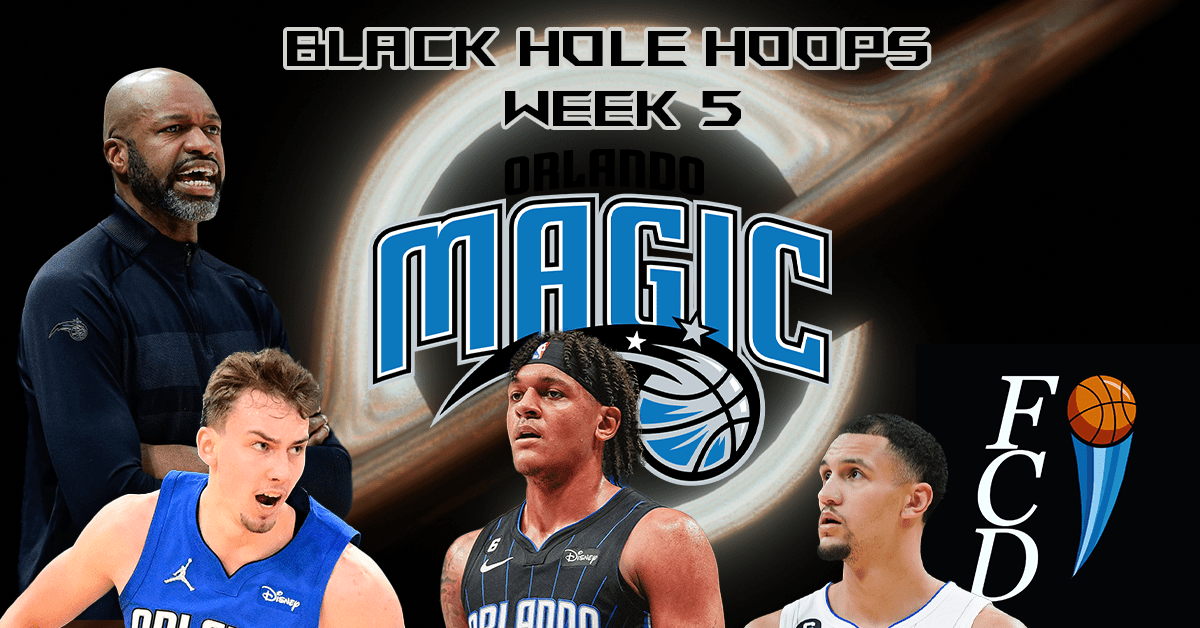
The Orlando Magic have now won seven straight games, with a list of victims that includes the Boston Celtics and Denver Nuggets. For hardcore hoops junkies, they have been must-see programming. However, when observing the media landscape, no one is really talking about just how good the Magic have been. With the lack of coverage comes a lack of understanding, so how have the Orlando Magic suddenly found themselves with a 7-1 record over the last two weeks? And is this level of success something they can sustain?
What immediately jumps out about the Magic is their defense. As of right now, they have the second-best defensive rating in the league, only allowing 107.5 points per 100 possessions. That isn’t just good, that is elite. And over the span of two days, they defeated two of the best teams in the NBA, even going so far as to hold the Celtics under 100 points. As a unit, they have more than earned the Black Hole Hoops nod.
Disrupting any team in the NBA is going to involve throwing their stars out of rhythm, and the Magic did exactly that against Boston, forcing Jaylen Brown and Jayson Tatum into a combined 13-38 (including 2-11 from three) from the floor. Brown in particular struggled mightily, shooting a horrible 6-22. What exactly had him so bothered?
Brown missed his final 13 shots in the game. Before he built the newest house in Brick City, he was torching the Magic with a performance to the tune of 6-9 from the floor. He then unraveled in the third quarter. First, he missed a stepback three. No big deal, that’s a tough shot. Then he missed a layup. Rising Magic star Paolo Banchero slid to contest, but it was still an easy opportunity due to Brown’s full head of steam. Brown drew a few different matchups, though the player who really gave him fits was Banchero. The only shot he hit against Banchero was a corner three in transition. He missed the next four shots.
One of things that makes the Magic an elite defense is their length. They have long, rangey players throughout the roster, and Paolo is the most prominent. He’s 6’10, he moves like a guard, and is blessed with a 7’1 wingspan. Even if he isn’t in the best position to block shots, he definitely alters them. All he had to do was step into Brown’s space and fight through some screens, and it was enough to bother Jaylen all night.
And that really is the tale of the tape. Even when Orlando was forced into situations where smaller defenders switched onto Brown, he was unable to capitalize on the opportunities due to stout defending and less than optimal shot selection. Just for reference, Cole Anthony guarded six of Brown’s shot attempts, and Brown missed all but one. Anthony is 6’2, Brown is 6’6.
Now, I’d hate to leave you wanting, but I’m cutting this piece short because the Magic deserve more than just a Black Hole Hoops nod. As I said at the top, they have been a must-watch for the first time since Dwight Howard was their star. Be on the lookout for more about the Orlando Magic soon from Full Court Dime. Know this: once they find their offensive identity, they are going to be a perennial playoff team, and they are only a few steps away from title contention.
All said, for beating both the Nuggets and Celtics in back-to-back games, the Magic as a unit have earned the Black Hole Hoops spotlight for Week 5 of NBA action. Keep your eye on them. They’re blossoming into a problem for the East.
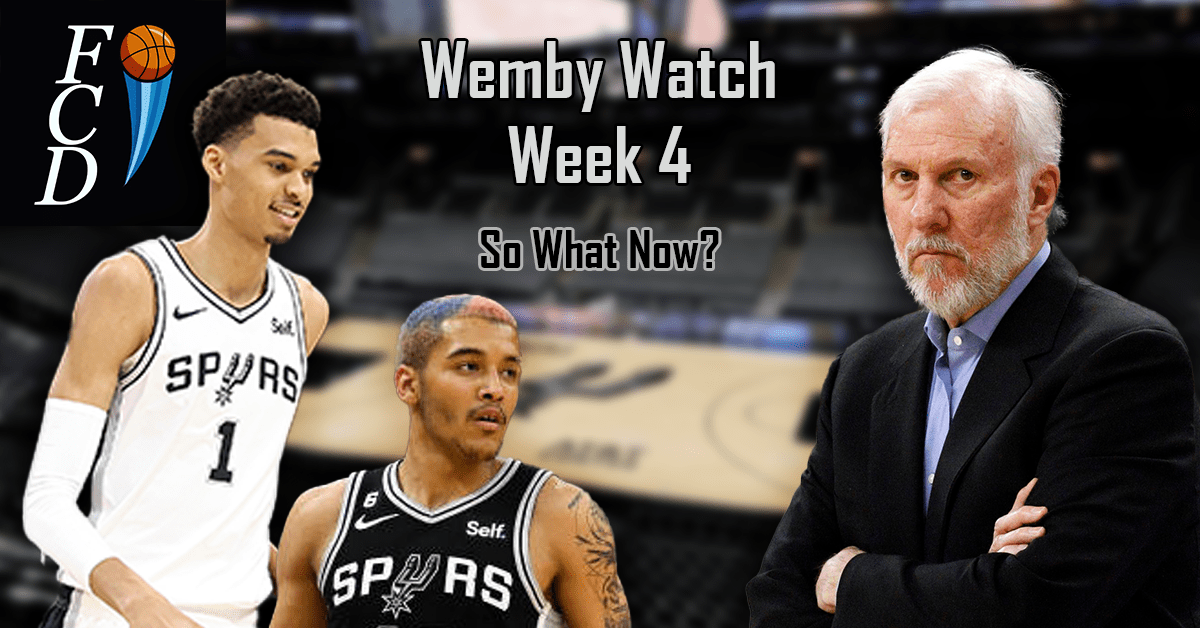
Disclaimer: The author is a lifelong San Antonio Spurs fan. He may be blinded by optimism.Also, “Wemby Watch” will now release every Friday.
At this point, every observer worth their salt knows what they are getting with the 19 year old phenom Victor Wembanyama. His ceiling is as high as anyone’s we’ve ever seen. I truly, genuinely believe that. No one at his size should be able to do the things he can do, yet he can. Sure, there are issues. He’s 19, there are going to be issues. It doesn’t matter if he has been a professional since he was 16, he has to adjust to the physicality of the NBA game. But despite his warts, he’s going to be a star. There is much uncertainty about the future of the San Antonio Spurs, and most of it lies in roles and rules. Let’s talk about it.
The Experiment
I want to be kind here. The Spurs have the worst guard rotation in the NBA. Backup guard Tre Jones is the only true point guard on the roster, and as much as I love him, he’s not the starting point guard of the future for San Antonio. That title has been thrust onto Jeremy Sochan, the second year player technically listed as a power forward. Gregg Popovich has stated Sochan at point guard is going to be a season-long experiment. Jeremy has, by his own admission, never played point guard in his life. It certainly shows. Obviously, becoming a team’s primary playmaker at the NBA level is challenging at best, and so far, Sochan has not lived up to it. Now, I like being optimistic, especially about young players. The guy is 20 years old, he has time to become whatever he wants to be. And frankly, if Gregg Popovich believes in him, so do I. Having said that, it has not been fun to go through the associated growing pains.
Sochan clearly looks uncomfortable at the position. Totally fair given the circumstances. But personally, as much as I trust the long-term vision Pop has, I think he is missing what is right in front of him: Keldon Johnson is the guy to convert into your starting point guard. It actually has some legs. First, let’s look at the stats. According to Cleaning the Glass, KJ is in the 93rd percentile among wings in assist percentage on a team that currently averages the third most assists per game (via NBA.com). He’s also in the 90th percentile in turnover percentage, only giving the ball up on 7.0% of his possessions. He and Sochan are averaging similar assist numbers (4.4 and 4.5 APG respectively) but Johnson only commits 1.1 turnovers per game as compared to Sochan’s 2.3 per game. In case it is unclear, that is a huge difference.
Stats don’t paint the full picture though. Let’s check the tape. We’ll start with the status quo of Sochan guard play. Let’s look at some examples from different games.
Click me
The above play isn’t exactly game breaking, and it is understandable to feel like I’m nitpicking a bit. But those are the kind of reads he needs to make if he is to be the point guard for the Spurs. Obviously, he doesn’t need to be perfect. Mistakes happen over the course of the game, they just can’t happen with consistency. To Jeremy’s credit, he got the offensive rebound and immediately located a wide open Wemby who clanked the three ball. And there are good things! Like this play!
Click me
It looks simple, but he made the right read. He saw the defense lose track of Devin Vassell and got him the ball on time and on target. He just wasn’t awarded with an assist. That was easy, though. Vassell couldn’t have been much more open. When things get more tense, he tends to lose himself within the game. One only needs to look at the Spurs’ November 14th matchup against the Thunder to see that. With 2:30 left in the second quarter, the Spurs were barely clutching onto a one point lead when this happened. See if you can discern Pop’s emotional state.
Click me
Did you see Popovich? Absolutely livid. After the Spurs coughed up the ball and gave up a score, he called time. According to ESPN, he was upset because Sochan didn’t bother to get the play call from his coach. For most other point guards in the league, that would have been a clear moment to see what their coach wanted to run, to see if their general had a plan to stop the bleeding. With his inexperience, Sochan just didn’t think about it.
The objective of pointing those things out isn’t to slam Sochan. I actually really like him and I think he’ll blossom into a quality, winning player and maybe even a secondary facilitator someday. Rather, the objective is to state the obvious: the experiment isn’t working. However, it’s not right to identify problems without presenting solutions, and the solution has been staring the Spurs in the face. Keldon Johnson is already equipped to be a stand-in point guard. The most obvious long-term fix is acquiring a real PG via trade or free agency. But KJ has the tools to run the team as the youngest roster in the NBA forges its identity. We already covered the stats, so what does the tape say?
Whether it is fueled by instinct or experience, it has to be stated that KJ is a good passer. At the very least, he is a passable one (I’m sorry, I had to do it). In seriousness, Johnson possesses enough passing skill and awareness to run an offense. Take this play for example, where he sees the defense wander too far into the paint off the corner shooter.
Click me
Maybe not a hard read, but he definitely made the right pass. I also like this next play, where Johnson found Sochan back-cutting his defender out of “zoom” action.
Click me
And yeah, KJ has his own problems at the point. For one, he throws far too many jump passes and has a tendency to get caught in the air with no real plan. He doesn’t have the tightest handle and can get caught in traffic. No one is asking him to be Magic Johnson or Kyrie Irving. But he could definitely be the team’s starting facilitator while Sochan slowly becomes more comfortable. Let it be reiterated: if Pop thinks Sochan can play the point, so do I. I’m just suggesting that removing the primary playmaking responsibilities from his shoulders might ease his burden and help him develop more quickly as he takes things in off the ball.
But there are more problems than just the lack of quality, facilitating guard play. The whole offense needs a tune up, made evident by its woeful 107.8 offensive rating. Gregg Popovich has made it clear: he doesn’t want to bestow crushing expectations on his players and he will slowly develop a system more tailored to their strengths. What should that system look like, though?
The New Spurs
I’ll try to keep it brief. In a previous “Wemby Watch”, I made mention of the Spurs employing more pinch post actions with Victor serving as the playmaking hub. He has the passing gene, and it’s not like anyone can get a hand in his face enough to inhibit his decision making. He is the future of the franchise and his poise at 19 years old has proved he can handle it. Let him do it all. Running pinch post, Wemby would get the ball at the elbow and have no teammates between him and the nearest sideline. His vision and willingness to pass would keep defenses honest as his teammates ran whatever actions they needed to get open while also giving him space to operate. If nothing else, he would be one-on-one with a defender who he could easily shoot over. If he had a big on him, he would get to use his handle to get to his spot.
And at this point, we all know what Wemby needs to work on. He needs to add strength, he needs to tighten up his handle (particularly against guards), and he needs to shore up some of his decision making. All of those things are true. But most of that is off-season work. The stuff to improve during the season is the tactical planning and execution. Pop still has the creative juice to draw up some confounding plays to befuddle defenses. If the earlier floppy action video didn’t convince you, here’s this weird elevator play for Doug McDermott.
Click me
The Spurs have a future. Even if they lost every game for the rest of the season, there would still be hope. They have a solid young core to build around. Every player seems more than willing to learn and sacrifice for the needs of the team. Despite having the 27th ranked offense, they currently average the 3rd most assists per game. That is astounding! There are bright spots for sure, and as the Spurs begin to find their identity, people will forget the pains it took to get there. But for now, the pains keep coming. I believe in the Spurs. I believe in Sochan, I believe in Wembanyama, and I certainly believe in Pop.
Last night, the Atlanta Hawks and the Indiana Pacers treated basketball fans to a sight uncommon. There were a total of 309 points scored, the final buzzer sounding with the scoreboard reading 157 to 152 in favor of the Pacers. While defense was in short supply, offense was surging in surplus. So what happens when two teams boasting top-5 offenses and carrying bottom-7 defenses collide? In a word: magic.
First Quarter: An Explosive Start
The opening quarter of action was a prelude of things to come. The Pacers put up 34 points, while the Hawks scorched them by scoring 40 points of their own. Other than a lack of defense being played, what happened? How did both teams manage such a feat?
For the Pacers, it was all about a balanced attack that saw the most success when getting to the rim. Take a look at their heat map for the quarter, a chart meant to show shot concentration.
While they did have some success behind the arc, they only shot 4-for-13. Certainly nothing to write home about, especially for a team shooting a scorching 39.3% from deep as a unit (that’s 4th best in the league, by the way). Conversely, they were 9-for-13 on all their shots inside the arc, and they found their stride in a variety of ways.
This Pacers team is aptly named, because they love to get out and run. And they’re good at it. Their speed causes so many match-up problems for teams who struggle to communicate in transition. Take this shot for example.
Running in transition caused enough confusion to force Clint Capela into a long closeout, and Bruce Brown is too savvy of a player to leave that opportunity untaken. But the attack wasn’t all transition. There were a lot of possessions where it felt as if the Hawks just didn’t put up any real resistance inside.
And look, that possession put Dejounte Murray in a tough spot. If he had rotated too early, Obi Toppin would have a lob. The Pacers’ spacing made the possession as a whole difficult to guard. That said, there didn’t seem to be much communication for the Hawks and it led to an easy layup.
Not to belabor the point, but here is another example of poor communication.
So yeah, the Pacers were pouring it on in the paint to start the game. Though if you recall, I said the Hawks scored 40 points of their own in the first quarter. In spite of their defensive foibles, they were a monster on the other end and they deserve some flowers.
Their attack looked very similar to the Pacers’. Get easy points in the paint and transition, and hit your threes. Seems easy enough. But the Hawks actually waited until the second quarter to flex their offense.
Second Quarter: Hawks Take Flight
The second quarter was all Hawks, which feels weird to say considering the 39 points scored by the Pacers. But hanging 46 points in a quarter is going to eclipse any lesser performance. It just felt like the Hawks couldn’t miss. They hit their first eight shots in a row. They hit 13 of their first 16. It was clear very early that the Hawks were feeling themselves. Just look at this bucket from Trae Young.
Three Hawks in particular had stellar performances in the quarter. Bogdan Bogdanovic, Dejounte Murray, and Jalen Johnson. Let’s tackle each guy really quickly.
Bogi shot a perfect 5-for-5. His first was a beautiful one dribble midrange pullup off of a double pindown. The rest of them… I mean, just look at them.
He also got to the free throw line three times and knocked down every one of them. It was the quintessential quarter for a shooter, where he rattled off 15 points on perfect shooting. Truly a chef’s kiss.
While he didn’t have a perfect quarter like Bogi, Dejounte Murray contributed 14 points of his own. He got to the rim, hit a middy, and shot the long ball well. If he sensed even a moment of hesitation from the defense, he attacked it.
However, the performance I most enjoyed from the Hawks came from Jalen Johnson, the third year player who has taken a big leap. I was impressed with him all game. His first basket of the quarter was a gorgeous post-up fadeaway and it was absolutely textbook.
And the rest of his quarter was nothing mind blowing, but he just did all the little things you want to see players do. He stayed aggressive, going to the charity stripe five times and cashing in all of them. He ran out in transition for easy points. He also showed awareness, slipping a screen to get an easy dunk when the Pacers’ defense fell asleep.
Between those three guys and contributions from other teammates, the Hawks went into the locker room at halftime up by 13. Surely they felt good, despite some of their earlier defensive missteps. But what they did not foresee was the retaliation in store: one of the most explosive third quarters of NBA basketball we are going to witness this season.
Third Quarter: Mount Hali Erupts
The story of the Pacers’ third quarter can be summed up in two words: Tyrese Haliburton. Haliburton is currently the best point guard of his era, and he proved it as the Pacers stormed back into the game. Of the staggering 46 points scored by Indiana in the third quarter, Hali was responsible for 36 of them. He only failed to score or assist on 10 points in the quarter. Absolutely otherworldly.
It would be reductive to only describe his scoring outburst by stating he went 7-for-8 from the three point line. But he went 7-for-8 from the three point line. His variety of head fakes and hesitations opened up the floor for scoring opportunities, and his vision and passing ability punished lax defenders. On top of that, all of his three point attempts came off the dribble save for one, meaning he created every single look with a live dribble. If you’re not a basketball person, I need you to understand the extreme difficulty and rarity of those shots (particularly at that volume).
I won’t spend much more time on Haliburton because we’ve already covered him this week, but make no mistake, he was a one man offense in the third quarter.
Fourth Quarter: The 309
With all the offense on display (and the frankly disgusting lack of defense), it was difficult to remember that fans were not being treated to a showcase but rather a high stakes in-season tournament game. With only three minutes left in the game, the Pacers were only up by two, the scoreboard showing a mind-boggling 145 to 143. Then, a few moments later, after an Indiana turnover, this happened.
I won’t spoil the way the game ended. You owe it to yourself to watch the entire game, but especially its ending. There were clutch buckets from both teams, and offensively speaking, neither of them have any reason to feel shame, even in defeat.
We don’t often get to see 300 point games. It’s even rarer to see them happen in regulation. Sure, they aren’t the best games of basketball. After all, there wasn’t anything close to approximating professional defense in this contest. But they do showcase the best that basketball has to offer. There was creativity and execution, a beautiful matrimony of artistry and system only achievable in basketball. The 309 will be a game I probably watch multiple times this year, and I think you should too. There won’t be many more like it.
Disclaimer: Black Hole Hoops is now releasing every Monday. Stay tuned to see our analysis of the best performances every week.
Nothing known to man can escape a black hole. Once something crosses its event horizon, there is no hope. Not even light can manage to break away. Similarly, there are times when basketball players become inescapable forces of nature, their will dominating a single game. These moments deserve to be cataloged and remembered. So welcome to Black Hole Hoops, a segment dedicated to highlighting the best performance from across the NBA from week to week.
The Indiana Pacers have cemented themselves as one of the most high octane offenses in the NBA this season. They play with pace, they constantly move, and the ball just pops and zips in their halfcourt. All of that can largely be attributed to the play of Tyrese Haliburton, the young point guard quickly proving he is the future of the position in the league. Across back to back games, Haliburton recorded 32 assists and zero turnovers. According to stats from Cleaning the Glass at the time of writing, he only turns the ball over 8.5% of his possessions, and he records an assist 49.4% of the time. He is unquestionably at the top of the league in both categories. The point guard position has been and will continue to be the most important position in the game. Even with the emergence of positionless basketball, it is still paramount to have a player who can 1.) manage the game (initiate actions and sets, be the coach on the floor, etc.) and 2.) read the room (make adjustments, react to changes, think on the fly). Haliburton does both of those at the highest level and he’s only 23 years old. He gets the nod for Black Hole Hoops in week four of NBA action, and here’s why.
Hali’s week four in-season tournament (IST) matchup against the Philadelphia 76ers is the perfect encapsulation of what he looks like at the peak of his powers. He ended the game with 15 assists, bolstered by 33 points, and topped off with two steals and a block. He committed only one foul and he never turned the ball over. It is one of the best games we will see all season. Haliburton’s true strength is his dynamism, whether he is attacking a defense himself or setting his teammates up to score. His second assist of the game is a good example of his ability to quickly read situations. Watch and listen to the video below.
Click me
He also does little things when passing the ball that just help it find its destination much more easily. For example, he throws this little no look to get Toppin an uncontested layup in transition. And it’s not like he’s the only guy able to throw this pass or anything, but it’s important for his team that he has this ability so they can generate the easiest points possible.
Click me
But make no mistake, he has some higher level reads in his game as well. The skip pass is one of the most powerful tools in a passer’s arsenal, allowing the offense to nearly instantly put defenses in a compromised position. It is also one of the most difficult passes to make, especially at the professional level. Beating the length and quickness of defenders at that level requires perfect timing and precise aim. Thankfully for the Pacers, Haliburton has both.
Click me
Or this pass here. At Full Court Dime, we appreciate the art of “fake a pass to make a pass.” Haliburton gave a textbook example of its effectiveness, using a subtle head fake/ ball fake combo to freeze the defense long enough to again find Obi Toppin near the rim.
Click me
All the passing prowess in the world can’t help a player if his teammates don’t take advantage, though. Haliburton is Obi Toppin’s favorite human (probably), but he isn’t the only one who gets easy points due to the passing prodigy. For example, he got Aaron Nesmith some easy points in the fourth quarter when the defense scrambled by punishing a help defender who helped just a little too much.
Click me
Or later in the fourth quarter when he found Myles Turner for a wide open three ball to put the Pacers up by six points with three minutes left to play.
Click me
And I’m sure some of you are thinking “There’s nothing special about that pass, he threw the ball to the open guy. Nothing ‘audacious’ there.” However, think about this: how many 23 year old guards would have thrown it instead of shooting? Moreover, how many 23 year old guards who shoot a career average of 40.3% from three make that pass? I’ll tell you how many: very few. Haliburton is a special talent because of his ability coupled with his intelligence. Because it’s not like he was having a hard time finding his shot. In fact, here are his first five shots of the game for proof.
Click me
Haliburton is a true three-level scorer. For further proof, this is his shot profile when Indiana gets into their halfcourt offense.
via Cleaning the Glass
While this game against Philly was mostly an onslaught from beyond the arc, make no mistake: Tyrese Haliburton can get a bucket from almost anywhere he pleases. A large contributor to that ability is his aforementioned passing powers, freezing defenders long enough to get himself open looks. Don’t forget, I said at the top of the article that he managed to get himself 33 points WHILE ALSO getting the 15 assists I’ve focused on. Every player may have weaknesses, but not every player is as hard to plan for as Tyrese Haliburton. It brings me great pleasure to award him the Black Hole Hoops title for week four, and I look forward to seeing more brilliant basketball from him and his Pacers this season.
Is it already time to consider this experiment a failure?
When last we left the LA Clippers, they were the league’s newest super team, ready to bring devastation to the Western Conference as they vied for control at the top. But since the trade that brought them James Harden, they have been winless. Their most recent loss was to the struggling and undermanned Memphis Grizzlies. While teams take time to gel together (especially when mixing star talent), it is time to be slightly concerned for the Clippers. Now, everything we covered in the previous piece about the Clippers remains true. They have the potential to be a team that plays its way into the Western Conference Finals. All of the pieces are in place, there is just the issue of making them fit together. The season is still young, but when expectations are high, there is very little room for error. Fans are at the point where they have to ask: what is wrong with the Clippers? And more importantly, can it be fixed?
Since the Harden trade, the Clippers have averaged 104 points per game, an awful number for a team so stacked with talent. Surely a team with Paul George, Kawhi Leonard, James Harden, and Russell Westbrook can score, right? Not necessarily. Turn your attention to Exhibit A: the first quarter against the Grizzlies. Be warned, it’s rough.
Their first two offensive possessions were truly offensive. The first was essentially a Westbrook turnover. But, it was the first possession and stuff happens throughout a game. Sometimes, you just turn the ball over, no need to over analyze. However, their second possession was a bad omen of things to come. Since getting Harden, they have liked getting him the ball on the elbow as a facilitator and standing Westbrook in the strong corner. In the weak corner, they run an option for Kawhi. He can either take a flex cut via a screen from PG to get through the paint, or he can curl to the wing off a screen from Zubac. In theory, it’s a great play design. See if you can spot the problem.
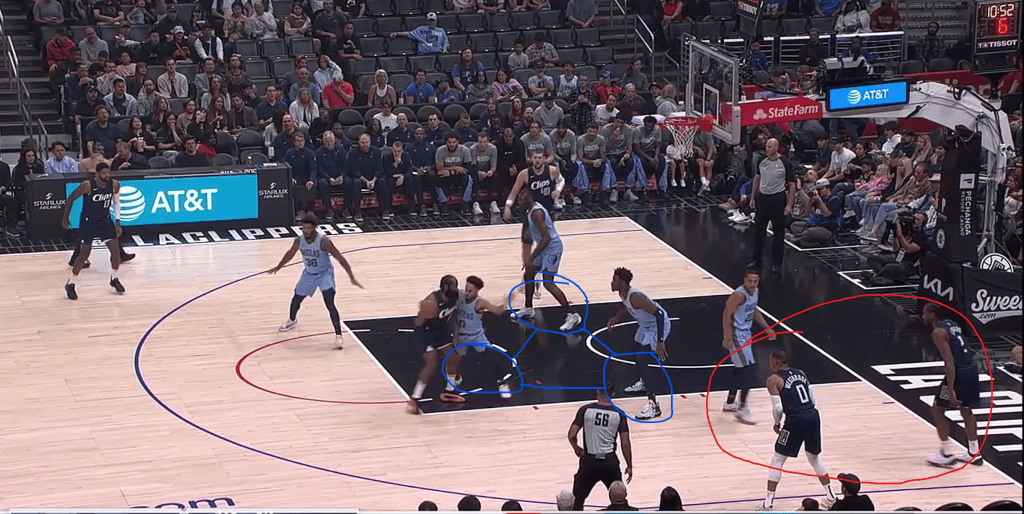
Did you see it? The commentators sure did. The offense, with some of the most dynamic scorers in the NBA, is stagnant. Now, credit where credit is due. The weak side defense did a great job disrupting the secondary action between PG and Zubac with physicality and communication. Notice all of the heavy lifting Marcus Smart (MEM #36) was doing, first digging down to dissuade a pass to PG before calling out a switch as Kawhi got through the paint. Then he top blocked PG as the latter attempted to gain an advantage with Zubac’s screen. Now, notice where this left the offense.
To be kind, the spacing on display is awful. The non-shooting threat of Westbrook in the corner allows his defenders to consistently ignore him to pack the paint and shrink the floor. Meanwhile, Kawhi just meandered into the deep corner where he and Westbrook could practically hold hands as the team scrambled their way to a bad shot. And the offense is a multilayered issue. Let’s start with the most obvious layers, and then we’ll move to some more nuanced conversation.
For one, the team is horrible in transition. According to stats from NBA.com, the Clippers are scoring an abysmal 0.87 points per possession on their transition offense, making them dead last in the league. Now, if they were just not a transition team, that would be one thing, but they are taking the fourth most shots in transition. Nearly 20% of their attempted shots come during fast breaks. The Clips are an isolation heavy offense. When teams commit large portions of their attack to iso ball, it can really disrupt the rhythm of their teammates. An easy way to reclaim some rhythm is in transition. If head coach Tyronn Lue wants to continue on the current path, he has to convince his guys to run the floor more. It might help take the lid off the basket when his team is struggling to score. More importantly, it would provide some much needed energy to the players.
With that said, if your team doesn’t score in transition, your halfcourt offense has to be top tier. In the modern NBA, a top tier system is predicated on spacing. If a team cannot stretch defenses, they cannot win. The Clippers have been a prime example in a really unfortunate way. Let’s look at another example from their loss against the Grizzlies.
The ball never switched sides of the floor. For 90% of the possession, Zubac stood in the dunker’s spot. Once PG was doubled, he was able to pass out of it, but Terance Mann was wide open in the weak corner. It seemed like the Clips were so focused on the ball side action that no one had the wherewithal to swing the ball to the open guy on the weak side. The Clips really struggle getting any kind of off ball movement or compelling actions away from the ball to get guys open. It is really disappointing, especially for such a good coach and talented team. So what’s the fix?
The more I have watched the Clips, the more I have disliked the high post initiation in their offense. I still think it has potential, but not as their go-to set. If they are really committed to their current starting five (more on that in a minute), they have to maximize their spacing. Just by initiating the offense higher, they can open up so many more options. Instead of putting Westbrook in the ball side corner, have him on the weak side. Whether he cuts or gets a screen or just stands around, have him away from the ball. If the defense tries to roam away from him, he can get the ball and attack the space rather than hoisting a shot. Even with his poor free throw shooting, he can at least help get his team into the bonus. And this isn’t just theorizing. Take a look at the first play of their most recent match-up against the Mavericks.
Even with sub-optimal spacing on the weak side, look how much more room there is to work with! Kawhi basically took a leisurely stroll into the paint. They used the same set to generate good looks multiple times in the first quarter. In fact, the entirety of the first quarter of the game against the Mavs looked good. Even with some lapses in defensive coverage, the team played with energy and executed their offense at a high level. But their problems reared their head in the second quarter where they were outscored 47 to 18. No, you did not read that incorrectly. By then, the game was over. But the song and dance remained the same. Bad spacing, no pacing, no off-ball movement, poor communication on defense. It was one of the ugliest periods of basketball I have ever seen at a professional level.
The media certainly has had a lot to say about the Clippers’ record after the Harden trade. They have pointed to his plus-minus total of -67 and tried to make him shoulder all the blame. While Harden certainly isn’t innocent, neither are the rest of them. At some point, the coaching staff needs to be held accountable. At some point, the other stars have to be held accountable (PG has played horribly since the trade save for the Grizzlies game). The Clips have failed to craft an offense that can maximize the talent they have. And so the question is raised: can the four superstars all play at the same time? So far, the answer appears to be a resounding “No.”
Here’s where the nuanced conversation comes in. The debate has centered around who to send to the bench, and it seems like much of the media agrees it should be Harden forced to sit and be the sixth man. But he was brought in to be the facilitator. Ask yourself an honest question. Would you rather have Russell Westbrook or James Harden being your decision maker? Give me the guy who takes slightly better care of the ball. Moreover, give me the guy who maximizes the available spacing on the floor. I don’t believe a front office makes the decision to trade for James Harden to send him to the bench. Is a simple change of lineup enough though? Tyronn Lue is a good coach. If nothing else, he is experienced. The listed failings of their offense are ultimately on his shoulders. Not having definitive lineups is on his shoulders. The pressure for him is enormous. Because no matter who he decides to sit, he then has to figure out the rest of the rotations and he especially has to figure out the playcalling/ design. Does Norman Powell move up to starting status to provide more spacing and shooting options? Does Terance Mann start to provide youthful energy? If Westbrook comes off the bench, how do you maximize his effectiveness with the current personnel? If Harden comes off the bench, do you lose his buy-in? Do you get really weird and move PJ Tucker up in the rotation to help on defense and space the offense?
I’m not a basketball expert. I’m a student of the game with a platform. I don’t have the answers to these questions, and even if I did, it wouldn’t matter. The Clippers’ players, coaches, and front office are on the hook for those answers. The Clippers still have a chance to be great. They have only been together four games (that Harden played in, anyway). There is still time to get things figured out. The basketball community needs to remember the lost art of patience. That said, if the Clippers prove unable to mesh, they will be the next great NBA failure. For their sake, I hope it doesn’t come to that.
Will star power win out, or are the Clips destined to fizzle?
The NBA already has a new superteam. Certainly didn’t take long. This week’s stack du jour is none other than the LA Clippers, who completed a blockbuster trade to bring the disgruntled James Harden back to his hometown after a disappointing stint in Philadelphia. For those keeping track, their starting five is now Russell Westbrook, Paul George, Kawhi Leonard, Ivica Zubac, and Harden. On paper, they are easily the best starting five in the NBA, and it’s not even close. But can these stars really mesh together? After all, there is only one ball, and the guys listed all operate at their best with the ball in their hands. It is way too early to tell if this new experiment is tenable in the long term, but after their first game together, they have to be feeling pretty good despite a loss, and because of that, we have to ask the question: how good does the team look?
Shocking no one, they look really good offensively. Tyronn Lue is one of the best coaches in the NBA and it seems to me he doesn’t get the flowers he deserves. If anyone can balance the egos and skills on this team, it’s him. He has already found some foundational elements for his offense that will be an absolute nightmare to guard. For example, their second possession saw Westbrook bringing the ball up and getting Harden the ball near the slot. From there, Harden served as the playmaking hub. From this possession, Westbrook was able to get downhill thanks to a Zubac back screen, but Harden didn’t like the look. Westbrook then screened for Kawhi in the weak side corner with some help from Zubac, allowing Kawhi to pick his spot with a creative horns action. Poor communication from the Knicks and a great screen from Zu got Kawhi a wide open three from the wing. He won’t miss many of those in the future.
Their next possession used the same design, but Zu got into a pick-and-roll with Harden instead of screening for Kawhi. They ended up getting free throws out of it.
Note: Harden threw this pass between Robinson’s legs. Filthy.
Of course, not everything ran smoothly. Hard to imagine any team becoming a well oiled machine in only a couple days. That said, even some of the stuff that didn’t work had promise. Still in the first quarter, the Clippers ran another play which saw Westbrook get Paul George the ball after a baseline pindown. Russ immediately ran P&R with PG, and just as immediately ghosted the screen to get the ball in space and moving downhill. If not for great anticipation from Quentin Grimes, he would have connected with a wide open Harden in the corner. And if Robinson had committed to stopping the drive too hard, Russ could have lobbed it to Zu. The Knicks defended the play well, but there were options. Good ones, too. In the future, look for Russ to give a hard head fake or even get in the air to feign shooting before firing his pass into the corner.
A theme from their first game together was getting Russell Westbrook into space. Much has been said about Russ in the media, but the guy can still play. It’s not like he’s barely holding on to a roster spot. He’s dangerous with a head of steam, and for the sake of his confidence, I like that his coaches and teammates are willing to give him room to operate. Even with some of the poor shot selections or ugly turnovers, he has a good ability to make reads out of drives. Take for example the play below.
This one is nothing crazy, but it is a nightmare to guard. The pass to Russ triggered the Spain P&R, where Mason Plumlee screened for Russ while getting a back screen of his own from PG. It was really well defended, but Plumlee’s defender had to respect Russ’ drive to the point that he allowed just the faintest window for Plumlee to get the ball back. He got it in a great position and was able to capitalize on the opportunity. The Knicks have started the year as arguably the best defense in the NBA. This action will not be well defended every night, and it will put immense pressure on defenses. Notice how when Plumlee made his move, Julius Randle lost Kawhi and let him drift to the wing completely undefended. If Plumlee would have kicked the ball out, it almost assuredly would have been three points for the Clips.
There were other things to like of course. PG was aggressive in posting up with smaller defenders on him and Harden led the bench well when he was the only superstar on the floor with them. But there were concerns as well. The most obvious being defensive. In fairness though, there were a few really good defensive stops for the Clips that were more than promising. Cleaning up some communication issues and coverages will keep them operating at a high enough level to potentially take them to the Western Conference Finals. The addition of PJ Tucker certainly doesn’t hurt the versatility either. There were also some visible frustrations on the offensive side as players were left unsure about a play call or had to direct their teammates to the right spots. All things that will come together as the team spends more time in the lab.
The Clippers are going to be really good. If not for some exceptional Knicks defense down the stretch, they would have won their first game together. On November 10th, they’ll have to face a scorching Dallas Mavericks team led by the best version of Luka Doncic we have seen to date. That matchup will prove to be a true test of their worthiness to compete at the top of the West, and the NBA world will be watching very closely.
Disclaimer: The author is a lifelong San Antonio Spurs fan. He may be blinded by optimism. Let him have this.
Twice this week, the San Antonio Spurs battled the Phoenix Suns, and twice this week, they emerged Victor-ious (admit it, you chuckled). I have previously covered Victor Wembanyama’s clutch time antics, but he showed so much more than killer instincts when going toe-to-toe with one of the basketball world’s most stacked teams. Now, I think it is worth noting that the Suns were not at full strength for either contest. But, they did resemble their final form in the week’s rematch, and when they were strong, Wemby showed strength of his own.
October 31st, Spurs @ Suns, 115-114
Once again, walking into the final quarter of play of their first meetup felt underwhelming. The Suns had done well in limiting Wemby offensively. After the first half, he was a disappointing 1-for-6 from the field. In the third quarter, he only took one shot. But once again, when his team needed him the most, he delivered. Are you sensing the theme?
He very quickly got himself going with a spot-up triple. Watch the clip below, and notice his feel for the game. He drifted into the open space and when his defender ventured into the paint to help, and he smoothly got into his shooting motion. Notice also the footwork. His left-right footwork getting into the shot is textbook guard shooting. He even staggered his steps to ensure he could easily flow into his motion. From a guy who is 7’4? Simply. Amazing.
One thing I have failed to talk about in detail is Victor’s basketball IQ. He isn’t just some lumbering beanstalk on the court, he is very much a reader of the game. Yes, he misses reads from time to time but he knows when his teammates get open. As his game matures, some of his more errant passes will turn into highlight reel dimes. Take for example the clip below.
Hitting a three in that moment would have been huge. The Spurs had shrugged off a rough game to bring the score within seven points. Hitting a three would have turned the Suns’ advantage into a two possession game. Rather than taking a three with two defenders in his vicinity, he recognized a defensive lapse. Jusuf Nurkic played drop coverage to prevent Tre Jones from getting to the rim, but he did not recover in time to Wemby who popped out to the three point line. Yuta Watanabe tried to close out to Victor and lost Osman on the cut. Admittedly, it is a simple read (guy open, get guy ball), but Wemby using a shot fake into the pass is a nice wrinkle that potentially made Osman’s path to the rim easier. I also think in the future, depending on the situation, he will learn to hit the corner man when his defender tries to stop the cut. That was not necessary in this particular situation, though I’m sure that read is on his radar.
It is no exaggeration to say Victor’s fourth quarter was audacious. With under a minute to play, the Spurs were down five. In those situations, teams have to execute perfectly on both ends of the floor to pull out the win. The Spurs had just given Kevin Durant of all people an easy dunk. The clock was ticking, and if they wanted to win, they needed to act quickly. Enter Wembanyama. After missing an ill-advised three pointer, the Spurs were fortunate enough to get an inbound opportunity. In the closing minutes of an NBA game, urgency is often confused with speed. Playing with urgency does not necessarily equate to playing quickly. Wembanyama played with urgency, and it showed in shots like this one.
Again, note the footwork. Exact same sequence as his aforementioned deep ball. How many rookies, with expectations as crushing as a neutron star, would have taken that shot? And how many of those would have nailed it with such poise? His expression after the fact tells the story of a man focused on the end, not on what just transpired. Melodramatic? Maybe, but the best things in sports are, and the drama hardly stopped there.
For whatever reason, no one in a Suns uniform found it prudent to box out the 7 ‘4 alien streaking toward the basket with under 10 seconds left to play, and Wemby made them pay with perhaps the easiest dunk of his life to make it a one point game.
Now, Victor did not win this game by himself. The entire team played well as the clock wound down, and some late game heroics from Devin Vassell and Keldon Johnson sealed Phoenix’s fate. However it is noteworthy to look at Victor’s fourth quarter as compared to the rest of the game. In total, he took 12 shots on the night. Five of them came in the fourth. He made all but one. While I’m not in love with him waiting to do his damage until the end, I cannot help but admire the artistry in it. With every game, he silences more and more naysayers. And in the rematch, he would put to rest any doubt that he had arrived and he is here to stay.
November 2nd, Spurs @ Suns, 132-121
The second battle with Phoenix would prove a greater challenge. For one, the Suns surely felt that they should have won the first contest. After all, it took a last second steal and layup to defeat them previously. For two, Phoenix would get to employ their one-two punch of Kevin Durant AND Devin Booker this time. Though they were still missing third co-star Bradley Beal, they had more than enough to put away the young, scrappy, and inexperienced Spurs. That is, until Victor Wembanyama decided to have the best game of his young career, scoring 38 points, grabbing 11 boards, and blocking four shots.
A large part of the reason for his coming out party is the fact that it appears as if his teammates are finally getting the hang of playing with him. After all, none of them has ever played with a 7 ‘4 wing with an 8ft. wingspan and buttery jumper. During the initial Spurs onslaught, Jeremy Sochan found a streaking Wembanyama in the paint for an easy dunk in transition. A couple minutes later, Sochan again found Wemby, this time standing in the paint essentially unguarded. Near the end of the first quarter, he had a putback after being stripped by Kevin Durant. A nice six point quarter to get himself going. But it was his second quarter where he really got himself into rhythm.
Victor went off for 13 points in nine shots during the second quarter. After his first shot barely rattled out, Tre Jones found him on a lob, and I love the recognition involved.
It started with “get” action at the top of the key with Tre Jones. Already, I love getting the ball into Tre’s hands. Jones has consistently looked for Wemby on lobs and has found him more often than not, including here. For some reason, the Suns had the 6’3 Eric Gordon guarding 6’11 Zach Collins down low. Collins then back screened Wemby’s defender, and notice the subtle second screen from Doug McDermott to ensure the big bodied Drew Eubanks could not make it back to Victor on time. Though it wasn’t needed (and not even a great screen), it showed some creativity in getting Wemby the ball near the rim. With Collins’ screen, Gordon was the help defender, and there was no way he was going to overcome the roughly 13-inch difference between himself and Wemby to bother the dunk.
For his next bucket, he picked on Gordon again, hitting a frankly disrespectful turnaround.
I mean, c’mon, what is Gordon supposed to do? It’s mean.
Oh, and just for good measure, he hit two threes to push San Antonio’s lead to 20 going into halftime.
If not for two shots that rattled out, Victor would have taken 25 points into the locker room. Instead, he had to settle for 20. And in the third quarter, he refused to let off the gas. Again, there were some really nice “Eureka!” moments with his teammates. His first made shot came off a beautiful lob from Malaki Branham off a give-and-go, and it just wasn’t a pass Branham would have made in the first four games of the season. It took only 29 seconds of game time before he got another such lob from Keldon Johnson, albeit that one was more a bail out pass. But hey, when you have a teammate with an 8ft. wingspan, sometimes you just have to throw it up to him and let him bail you out (side note: Wemby again victimized Eric Gordon. Ouch). Even if it felt like a bit sloppy in execution, the IQ was on display yet again. It was simple. All he did was ghost a screen for Keldon after he recognized that no one was in the paint. Once Eubanks committed to stopping the ball, it was over, and Wemby made the Suns pay with a nice finger roll.
Not every lob was a success. He did miss one in the third, but the threat is always present, and teams have to either respect it or get punished. He also showed off some skills, punishing Eubanks’ strength with a little finesse and a jaw dropping finish.
But wouldn’t you know it, this game had fourth quarter heroics from Wemby too. As if he again needed to prove he can show up in crunch time. With 3:33 left to the play, the young Spurs let the Suns claw their way back into the game. Durant and Booker hit their fair share of clutch shots. The crowd’s energy was empowering their beloved Suns. Things appeared dire. San Antonio’s inexperience was on full display. They were going to blow the game, not dissimilar to Suns’ very own choke job only days prior. Victor would not let them spoil his career night. After grabbing the rebound and making his way down the floor, he ended the possession by baptizing Eubanks off the gorgeous Collins feed.
For good measure, Victor made three of his four free throw attempts in the fourth quarter. The guy keeps coming up big. By now, we have watched his play for two weeks. In the grand scheme of things, that isn’t a lot to go on. However, there are some things I would like to see improve. For Victor’s part, his handle needs work. It is good enough to get him by slow footed bigs, but things get dicey once he gets into traffic. I’d also like to see him not leave the floor so often on defense, especially inside the three point line. He’ll get plenty of blocks by being patient, no need to give guys free points by fouling them on pump fakes. As for the Spurs’ system, there has to be more pinch post and splits coming. I’ve already discussed Wemby’s IQ. He has what it takes to be a playmaking hub. Sure, it isn’t something to go to every time down the court. But there is a lot of potential. Between that and dribble handoffs with Devin Vassell, expect to see a diverse playbook from San Antonio as the season progresses.
The Spurs’ next game is November 5th against the Toronto Raptors, and it will be interesting to see how Victor Wembanyama responds after his 38 point, 10 rebound performance in Phoenix.
Nothing known to man can escape a black hole. Once something crosses its event horizon, there is no hope. Not even light can manage to break away. Similarly, there are times when basketball players become inescapable forces of nature, their will dominating a single game. These moments deserve to be cataloged and remembered. So, allow me to introduce you to Black Hole Hoops, a segment dedicated to highlighting the best performance from across the NBA from week to week. How fitting it is that the first subject of this segment be none other than the Dallas Mavericks’ own Luka Doncic, a man who has gravity similar to a black hole. On October 27th, he led the Mavs to a come from behind victory with 49 points, 10 rebounds, and seven assists, all while shooting 64% from the floor. Oh, and he hit the most clutch shot in the young season. Let’s take a look at how he did it.
Luka started the game by hitting back to back threes, then adding a third shortly after. No matter who the opposing team is, that is a bad omen. The three ball is what gives Luka some of his basketball superpowers, providing spacing and forcing defenders to play him honestly from behind the arc. If he hits those shots, opponents have to focus on getting him off the three point line, and forcing Luka to handle the ball in traffic and operate out of drives is not exactly a winning strategy.
Because if you are content with forcing Luka Doncic into drives, you prompt possessions like this one.
Note the physicality in that bump. Luka brought physicality all night, and it managed to get him 10 free throws (seven of which he hit). When he’s locked in behind the arc AND making physical drives, he’s essentially unstoppable. He’s also one of those guys teams cannot afford to double due to his vision and passing ability. He had a steady diet of the looks he likes. The addition of rookie Derek Lively II in the starting line-up gave Luka a nice lob threat, and I think head coach Jason Kidd will cook up some schemes to get them more involved in pick-and-roll to really put pressure on the back end of defenses.
But Luka’s favorite target of the night was Tim Hardaway Jr. Let’s look at the first find.
Let’s break down this defense really quickly. At that point in the game, Luka had nine points on five shots from the field. During the above possession, former Mavs teammate Dorian Finney-Smith was trying to force Luka into a drive. As Luka beat DFS and got into the paint, notice how Brooklyn got bodies into the lane to stop any easy attempts. Not only did it deter Luka from getting to the rim, it also stopped a potential lob to Lively. The problem is that once Luka picked up his dribble and stepped through, Thomas fell asleep and did not attempt to make it back to his man in the corner. From there, Luka threw his famous skip pass and Hardaway did the rest against a closing Thomas. Of course, the Nets took away that skip to the corner later on but…
In the third quarter, the Mavs ran a stagger screen for Luka that forced Ben Simmons to switch off of him in favor of the smaller Cam Thomas. Luka used his size to bully Thomas before recognizing that the defense had left the corner vacant again. Spencer Dinwiddie’s closeout was hampered by Josh Green and he couldn’t quite make it back in time to help.
But the best things came in the fourth quarter, where Luka made all four of his attempts. His first shot was a step back on the right wing to make it a one possession game with three minutes left to play. A clutch shot to keep his squad within striking distance late in the game.
Almost a minute of game time later, the Mavs ran a set for Luka to get the ball on the same wing. With Maxi Kleber as the facilitator, Luka set a pindown for Kyrie Irving in the paint. Hard to say for certain, but it appeared as if a Nets miscommunication caused a defensive breakdown. Simmons switched off Luka to take Kyrie, and based on Mikal Bridges’ reaction, it looked as if that was not the plan. Bridges and Dinwiddie then fail to communicate on the pindown for Luka, leaving Dinwiddie in an awkward closeout situation. Luka gave him a jab step that bought him just enough time to connect on another three ball.
Then the Mavs got the ball back. 1:32 left to play and they were down two. Luka called his own number in isolation and hit the following shot to put them up one point.
But the moment of truth arrived right at the end. Just watch this insanity.
If that isn’t basketball magic, I don’t know what is. That shot is hands down the most clutch of the season thus far, and it proved too much for the Nets to overcome. The whole night for Luka was spectacular. It felt like he got whatever look he wanted all night, and if he wasn’t shooting, he was making the right read. The most impressive stat in such a heliocentric game is his zero turnovers. Not once did he give the ball up to the other team. If the season ended today, Luka Doncic would be the MVP hands down. Through three games, he is averaging 39.0 points, 11.7 rebounds, and 9.7 assists per game. Absolute insanity. It is with great pleasure that I award him the Black Hole Hoops title this week, and if the rest of his performances are anything to go by, I’m sure this will not be the last time he gets the nod this season.






 Full Court Dime